

Casting and Forging Together: When One Process Is Not Enough

Casting and forging can be combined in a cast-forging process, in which a cast preform is first made and then forged into the final component. This approach is useful when a part needs the design flexibility of casting and the improved strength, density, and reliability of forging.
In many industrial projects, the best solution is not to choose casting or forging. It is knowing which parts should be cast, which should be forged, and how both processes can work together in a single finished product or assembly.
Casting creates parts by pouring molten metal into a mold, making it useful for complex shapes and near-net components. Forging shapes solid metal under compressive force, creating stronger parts by orienting grains and improving mechanical properties.
For industrial buyers, engineers, and procurement teams, combining casting and forging can help improve part performance, reduce unnecessary machining, control lifecycle cost, and support more reliable production.
Key Takeaways
Cast-forging combines casting and forging into a single production process.
A cast preform gives the part a rough or near-net shape before forging.
Casting supports complex geometry, while forging improves strength and mechanical performance.
This approach can reduce material waste, machining time, and unnecessary forming steps.
Cast-forging may be useful for parts that need both design flexibility and high-stress performance.
The right process depends on part geometry, load requirements, material, tolerances, and final application.
What Is Cast-Forging and How Does a Cast Preform Work?
Cast-forging is a hybrid manufacturing process in which a cast preform is first created, then forged into the final component. The cast preform gives the part a near-net shape, while the forging stage improves strength, density, grain structure, and overall performance.
This approach is useful when a part needs the design flexibility of casting but also requires the added toughness and reliability of forging. A simple process flow looks like this:
Design → Cast Preform → Forging → Machining → Finishing → Inspection
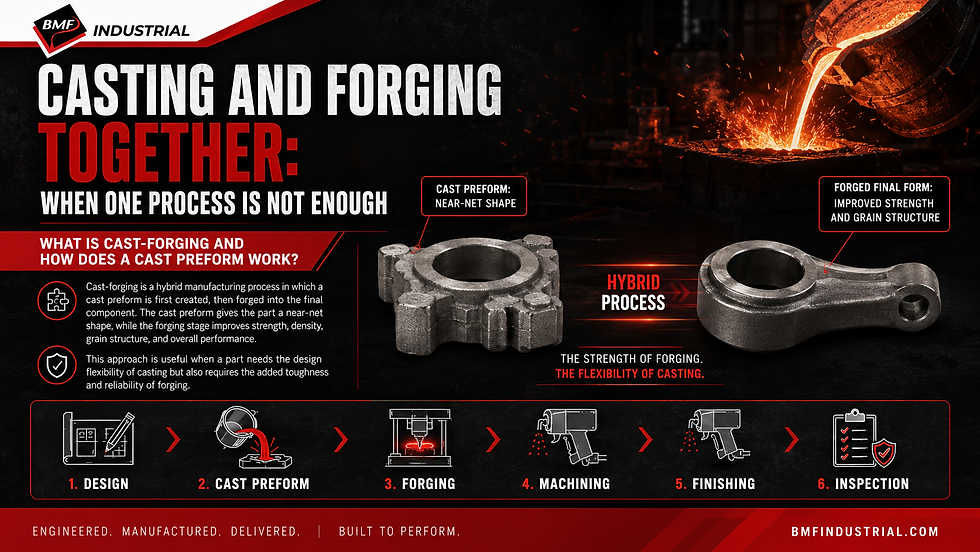
A cast preform is not always the final part. Instead, it acts as a shaped starting point for the forging process. Compared to a standard billet or bar, a cast preform can be made closer to the final geometry, which may reduce the amount of forming, machining, or material removal needed later.
Why Use a Cast Preform Instead of a Standard Billet?
Traditional forging often starts with a billet, bar, or ingot material. This works well for many parts, especially when the shape is simple or the forging process is already efficient. However, some components have more complex geometry, uneven mass distribution, or features that are difficult to create efficiently from a basic starting shape.
A cast preform can help solve this problem by starting the forging process closer to the final part shape.
Manufacturers may use a cast preform to:
Improve material distribution before forging
Reduce waste from excess stock
Limit the number of forging steps
Support more complex geometries
Reduce machining after forging
Improve consistency in repeat production
Near-net-shape manufacturing is often used to reduce cutting and finishing operations, save raw material, reduce variability, and improve production efficiency.
When One Process Is Not Enough
Casting alone may create the right shape, but it may not always provide the strength, density, or grain structure needed for a high-stress component. Forging alone may deliver excellent strength, but starting from a simple billet can require more forming work, more material, or more machining for complex shapes.
This is where cast-forging can be useful.
A part may need both processes when it requires:
Complex geometry
Near-net shaping
Better material distribution
Improved strength
Reduced porosity
Higher density
Fatigue resistance
Impact resistance
Reduced machining waste
Instead of treating casting and forging as separate choices, cast-forging uses each process where it adds the most value.
Casting for Shape, Forging for Strength
The easiest way to understand cast-forging is this:
Casting creates the shape. Forging improves the structure.
Casting is useful when a part has curves, cavities, uneven sections, or complex geometry. The molten metal can flow into a mold and form a shape that may be difficult to achieve through machining or forging alone.
Forging is useful when a part needs better strength, toughness, and fatigue resistance. During forging, compressive forces alter the metal's internal grain structure. The Forging Industry Association explains that forging can orient the grain structure to the part shape, improving strength, ductility, and resistance to impact and fatigue.
Together, the two processes can support parts that require both shape efficiency and mechanical performance.
How the Cast-Forging Process Works
The exact process depends on the material, part design, and performance requirements, but a typical cast-forging workflow includes the following steps.
1. Part Design and Engineering Review
The process begins with the part design. Engineers review the shape, stress points, load requirements, tolerance needs, and final operating environment.
At this stage, the team determines whether the part should be cast, forged, machined, or produced through a hybrid cast-forging approach.
2. Cast Preform Design
Next, the cast preform is designed. The preform is not simply a rough copy of the final part. It must be shaped in a way that supports proper material flow during forging.
A good cast preform design considers:
Final part geometry
Metal flow during forging
Shrinkage during casting
Allowance for machining
Stress-bearing areas
Forging die requirements
Material behavior under pressure
This step is critical because the preform affects how well the forging stage performs.
3. Casting the Preform
The selected metal is melted and poured into a mold to create the cast preform. The goal is to produce a near-shape component with the right material distribution before forging.
The casting stage can help create shapes that would be inefficient to form from a basic billet.
4. Forging the Cast Preform
After the cast preform is prepared, it is forged into the final or near-final shape. The forging stage applies compressive force to improve the internal structure of the part.
Forging can help improve:
Density
Strength
Toughness
Grain refinement
Fatigue resistance
Impact resistance
Mechanical reliability
Research on steel components made from cast preforms has explored the feasibility of combining simulation, casting, and forging to evaluate properties such as porosity and component quality.
5. Machining and Finishing
After forging, the part may still need machining and finishing. This can include CNC machining, drilling, threading, grinding, heat treatment, surface coating, or inspection.
Machining and finishing bring the part to its final tolerances, surface quality, and application requirements.
Benefits of Cast-Forging for Industrial Parts
Cast-forging is not needed for every component. However, when a part has the right combination of complexity and performance requirements, it can offer several operational and procurement benefits.
Better Shape Efficiency
A cast preform can start closer to the final part geometry than a basic billet. This can reduce material waste and help simplify later forming or machining steps.
For complex parts, this may improve production efficiency and reduce unnecessary stock removal.
Better Part Performance
When each component is matched to the right process, the final assembly can perform better. Cast parts can support shape and design needs, while forged parts can handle stress and load requirements.
This helps reduce the risk of using a part that is either underbuilt for its application or overbuilt in a way that increases cost without adding value.
Reduced Machining Waste
Because the cast preform is closer to the final shape, less material may need to be removed during machining. This can help reduce scrap, machining time, and total production cost.
Lower Lifecycle Cost
A part that is made with the right process can last longer and perform more reliably. Cast-forging may help reduce lifecycle costs by lowering replacement frequency, avoiding premature failure, or reducing unnecessary machining.
Better Production Consistency
Once the cast preform and forging processes are finalized, manufacturers can create a more repeatable production flow. This can help procurement teams improve supply chain consistency and reduce variation across repeat orders.
When Should Manufacturers Consider Cast-Forging?
Manufacturers should consider cast-forging when a part needs both complex shaping and improved mechanical performance.
Cast-forging may be a good fit when the part has:
Complex geometry
Uneven cross-sections
High-stress areas
Load-bearing requirements
Impact exposure
Repeated fatigue cycles
Expensive machining requirements
High material waste from billet forging
Tight performance requirements
It may also be useful when casting alone does not provide enough strength or when forging from a standard billet creates too much waste or requires too many forming steps.
When One Process May Be Enough
Cast-forging is useful when a part needs both complex shaping and improved strength, but it is not always necessary. In some cases, custom casting or forging alone may be the more practical and cost-effective choice.
Custom casting alone may be the better option when the part requires a complex shape but does not need the added strength of forging. This is often the case for components with detailed features, internal cavities, or lower-to-moderate stress requirements.
Casting may be enough for:
Housings
Covers
Brackets
Fittings
Large components
Decorative or detailed parts
Low-to-moderate stress applications
Parts with internal cavities
If the part is not exposed to heavy loads, repeated impacts, or constant stress, adding a forging step may increase costs without providing sufficient performance benefits.
Forging alone may be the better option when the part needs maximum strength but has a simpler shape. If the component can be efficiently formed from billet or bar stock, a cast preform may not be needed.
Forging may be enough for:
Shafts
Pins
Hooks
Couplings
Gears
Structural hardware
Load-bearing components
High-stress machinery parts
In simple terms, use casting when shape is the main priority, use forging when strength is the main priority, and consider cast-forging when the part needs both.
Cast-Forging vs. Casting vs. Forging
Factor | Casting | Forging | Cast-Forging |
Best For | Complex shapes and detailed features | High-strength, load-bearing parts | Complex parts that also need improved strength |
Starting Material | Molten metal poured into a mold | Solid billet, bar, or ingot | Cast preform |
Shape Flexibility | High | Moderate | High |
Strength | Good for many uses | High | Improved through forging |
Material Waste | Often lower for complex shapes | Can be higher for complex parts | Can reduce waste compared to billet forging |
Machining Needs | Varies by part | Often needed for final tolerances | May reduce machining compared to billet-based production |
Typical Use | Housings, fittings, brackets, covers | Shafts, hooks, pins, couplings | Complex high-performance industrial parts |
Real-World Applications for Cast-Forging
Cast-forging may be considered in industries where parts need both shape flexibility and mechanical reliability.
Heavy Equipment
Heavy equipment components often face heavy loads, impact, and wear. A cast preform may help create the initial shape, while forging can improve strength in critical areas.
Construction Hardware
Construction components may require both complex forms and load-bearing performance. Cast-forging can support parts that need custom geometry without sacrificing strength.
Rail and Transportation
Rail and transportation components often experience vibration, fatigue, and repeated stress. Forging helps improve reliability, while casting can support more efficient preform geometry.
Pump and Valve Components
Some pump and valve parts may benefit from near-shape casting followed by forging, especially when the part requires corrosion resistance, strength, and precise finishing.
Industrial Machinery
Machinery parts may require a balance of shape, strength, and repeatability. Cast-forging can be useful when standard casting or forging alone does not meet the full requirement.
Common Mistakes When Considering Cast-Forging
Using Cast-Forging When Casting Alone Is Enough
Not every cast part needs to be forged. If the part is not under high stress, the extra forging step may not provide sufficient value.
Using Forging When the Shape Is Too Complex
Forging from billet may become inefficient if the part has unusual geometry or uneven material distribution. In these cases, a cast preform may help improve the process.
Ignoring Preform Design
The cast preform must be designed for forging, not just casting. Poor preform design can lead to material flow issues, defects, or unnecessary machining.
Focusing Only on Upfront Cost
The lowest upfront cost may not deliver the best long-term value. Procurement teams should consider lifecycle cost, downtime risk, replacement frequency, and production consistency.
Not Planning for Machining and Finishing
Cast-forged parts may still require machining and finishing. These steps should be included in the production plan from the beginning.
Procurement Benefits of Cast-Forging
For procurement teams, cast-forging can support more than just part performance. It can also improve sourcing and long-term cost control when used correctly.
Potential procurement benefits include:
Reduced material waste
Lower replacement frequency
Improved part consistency
Better supplier planning
Reduced lifecycle cost
Fewer emergency orders
Improved production efficiency
The key is choosing cast-forging only when it solves a real production or performance problem.
How BMF Industrial Helps With Casting, Forging, and Finishing
BMF Industrial supports custom industrial hardware projects that require the right combination of casting, forging, machining, and finishing.
Instead of forcing every part into a single manufacturing method, BMF Industrial helps evaluate each part’s geometry, strength requirements, material needs, production volume, and final application. This helps determine whether casting, forging, cast-forging, or a combination of processes is the best fit.
From design support to production and delivery, BMF Industrial helps manufacturers and procurement teams create parts that meet performance, durability, and cost requirements.
Ready to Choose the Right Process for Your Part?
Cast-forging can be a strong option when one process is not enough. A cast preform provides shape flexibility, while forging improves strength, density, and mechanical reliability.
For industrial projects, the right manufacturing process can reduce waste, improve performance, lower replacement frequency, and support more efficient production.
Need help deciding between casting, forging, or cast-forging? Contact BMF Industrial today.
Frequently Asked Questions
What Is Cast-Forging?
Cast-forging is a hybrid manufacturing process in which a cast preform is first produced and then forged into the final component. It combines the shape flexibility of casting with the strength benefits of forging.
What Is a Cast Preform?
A cast preform is a rough or near-net-shape casting used as the starting point for forging. It gives the part a shape closer to the final design before the forging stage.
Why Use a Cast Preform Before Forging?
A cast preform can reduce material waste, improve material distribution, limit forming steps, and make complex parts easier to forge.
Is Cast-Forging Stronger Than Casting Alone?
In many cases, yes. The forging stage can improve density, grain structure, strength, toughness, and fatigue resistance compared with casting alone.
Is Cast-Forging Cheaper Than Forging?
It depends on the part. Cast-forging may reduce waste and machining for complex parts, but it also adds a casting step. It is usually considered when the performance or production benefits justify the added process.
When Should I Use Cast-Forging?
Use cast-forging when a part requires the complex geometry of casting and the strength or durability of forging. It is most useful for industrial parts that cannot be optimized through casting or forging alone.
Do Cast-Forged Parts Still Need Machining?
Often, yes. Cast-forged parts may still need CNC machining, drilling, threading, grinding, heat treatment, coating, or inspection to meet final specifications.
What Industries Use Cast-Forging?
Cast-forging may be used in heavy equipment, construction, rail, transportation, pump and valve manufacturing, and industrial machinery applications where parts need both shape efficiency and mechanical strength.


Comments