

CNC Machining 101: Everything You Need To Know
- 2 days ago
- 10 min read
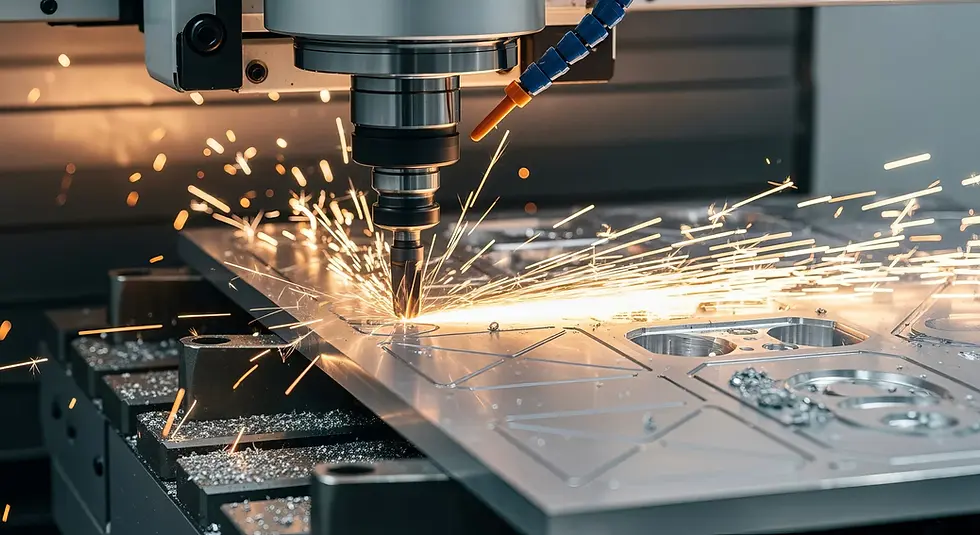
CNC (Computer Numerical Control) machining is a manufacturing process that uses computer-controlled machines to precisely cut, drill, mill, bore, and shape metal or other materials into finished parts. CNC machining produces highly accurate, repeatable components used across industries such as construction, hydraulics, aerospace, automotive, agriculture, and industrial manufacturing.
Key Takeaways
CNC machining uses computer-controlled equipment to manufacture highly precise components.
The process offers excellent accuracy, repeatability, and consistency for both prototypes and production runs.
Common CNC operations include milling, turning, drilling, boring, tapping, and threading.
CNC machining works with a wide variety of materials, including steel, stainless steel, aluminum, brass, bronze, and engineering plastics.
Precision machining is often combined with casting or forging to produce finished industrial components.
Tight tolerances and rigorous quality control help ensure reliable performance in demanding applications.
Manufacturing precision components requires more than cutting metal. Every dimension, hole, surface, and tolerance must meet exact specifications to ensure the finished part performs as intended.
This is where custom CNC machining plays a critical role.
From hydraulic valve bodies and pump housings to industrial hardware and heavy equipment components, CNC machining allows manufacturers to produce complex parts with exceptional accuracy and consistency.
Whether you're an engineer designing a new component or a procurement professional sourcing a manufacturing partner, understanding the CNC machining process can help you make more informed production decisions.
What Is CNC Machining?
CNC machining is a subtractive manufacturing process that removes material from a solid workpiece using computer-controlled cutting tools.
Unlike manual machining, where an operator controls the machine by hand, CNC machines follow programmed instructions that guide every movement with exceptional precision.
The process begins with a digital CAD (Computer-Aided Design) model. That design is converted into machine instructions using CAM (Computer-Aided Manufacturing) software, allowing the machine to automatically perform machining operations.
Because the machine follows programmed toolpaths, manufacturers can produce identical parts repeatedly while maintaining extremely tight tolerances.
How CNC Machining Works
Although machining methods vary depending on the part, most CNC machining projects follow a similar production workflow.
1. Part Design
The process begins with a CAD model or engineering drawing that defines the component's dimensions, tolerances, and material requirements.
2. CAM Programming
The CAD model is imported into CAM software, where machining toolpaths are generated.
These instructions determine:
Tool selection
Cutting speeds
Feed rates
Machining sequence
Tool movements
The completed program is then loaded into the CNC machine.
3. Material Preparation
The appropriate raw material is selected based on the application.
Common materials include:
Carbon steel
Stainless steel
Aluminum
Brass
Bronze
Cast iron
Ductile iron
Engineering plastics
The workpiece is securely mounted before machining begins.
4. Precision Machining
The CNC machine removes material according to the programmed toolpaths.
Depending on the design, multiple machining operations may be performed before the part is complete.
5. Inspection
After machining, the finished component undergoes dimensional inspection and quality verification before moving to finishing or assembly.
Benefits of CNC Machining
CNC machining has become one of the most widely used manufacturing processes because it offers several advantages over manual machining.
Exceptional Accuracy
Modern CNC machines can manufacture parts with extremely tight tolerances, making them ideal for precision industrial applications.
Excellent Repeatability
Once a machining program is developed, identical parts can be produced consistently throughout large production runs.
Complex Geometries
CNC equipment can produce intricate shapes, internal features, and detailed components that would be difficult or impossible to manufacture manually.
Improved Production Efficiency
Automation reduces manual intervention while increasing production speed and consistency.
Better Surface Finish
Precision cutting tools and controlled machining parameters help produce smoother surface finishes that often require less secondary processing.
Reduced Material Waste
Because the machining process is carefully programmed, material removal is optimized to minimize waste while maintaining quality.
Types of CNC Machines
Different CNC machines perform different manufacturing operations depending on the part design.
The table below summarizes the most common types.
CNC Machine | Primary Function | Typical Applications |
CNC Milling Machine | Removes material using rotating cutting tools | Valve bodies, housings, brackets, industrial components |
CNC Lathe | Rotates the workpiece while cutting | Shafts, bushings, pins, cylindrical parts |
CNC Drilling Machine | Produces precise holes | Mounting holes, ports, fastener locations |
CNC Boring Machine | Enlarges existing holes | Hydraulic components, bearing housings |
CNC Grinding Machine | Produces high-precision finishes | Tight-tolerance surfaces, hardened components |
Each machine plays a specific role depending on the component's design and functional requirements.
Common CNC Machining Operations
CNC machining includes a variety of operations that shape, refine, and finish a component. Depending on the design, a single part may require several machining processes before it is complete.
Below are some of the most common CNC machining operations used in industrial manufacturing.
CNC Milling
CNC milling uses rotating cutting tools to remove material from a stationary workpiece.
It is one of the most versatile machining operations and is commonly used to create:
Flat surfaces
Slots
Pockets
Grooves
Complex contours
Valve cavities
Mounting surfaces
Milling is frequently used to machine hydraulic valve bodies, manifolds, industrial hardware, and custom cast or forged components.
CNC Turning
In CNC turning, the workpiece rotates while a stationary cutting tool removes material.
Turning is commonly used to manufacture cylindrical parts such as:
Shafts
Bushings
Sleeves
Pins
Rollers
Hydraulic fittings
Because the material rotates during machining, turning is highly efficient for producing round components with consistent diameters.
CNC Drilling
Drilling creates accurately positioned holes in a workpiece.
This operation is used for:
Bolt holes
Fluid ports
Fastener locations
Thread preparation
Mounting features
Modern CNC drilling provides excellent positional accuracy and repeatability, making it suitable for complex industrial components.
CNC Boring
Boring enlarges and finishes existing holes to achieve precise diameters and smooth internal surfaces.
It is commonly used for:
Bearing housings
Hydraulic cylinders
Valve bores
Pump housings
Boring helps ensure proper fit between mating components.
CNC Tapping and Threading
Many industrial components require threaded holes for fasteners, fittings, or hydraulic connections.
CNC tapping and threading produce consistent threads while reducing the risk of damage compared to manual methods.
CNC Grinding
Grinding is typically one of the final machining operations.
It removes very small amounts of material to achieve:
Tight dimensional tolerances
Improved surface finish
High precision
Better sealing surfaces
Grinding is commonly used for hydraulic components and precision industrial equipment where surface quality is critical.
CNC Milling vs. CNC Turning
Although both processes remove material using computer-controlled equipment, they serve different purposes.
Feature | CNC Milling | CNC Turning |
Workpiece | Stationary | Rotates |
Cutting Tool | Rotates | Stationary |
Best For | Complex shapes and flat surfaces | Cylindrical components |
Common Parts | Valve bodies, manifolds, brackets | Shafts, bushings, pins |
Many industrial components require both milling and turning during production.

Common Materials Used in CNC Machining
One of CNC machining's biggest advantages is its ability to work with a wide range of materials.
Material selection depends on:
Mechanical strength
Corrosion resistance
Wear resistance
Weight
Machinability
Cost
Operating environment
Below are some common machining materials:
Material | Common Applications |
Carbon Steel | Heavy equipment, industrial machinery |
Stainless Steel | Corrosion-resistant components, marine equipment |
Aluminum | Lightweight industrial parts |
Cast Iron | Pump housings, valve bodies, machine bases |
Ductile Iron | Hydraulic components, heavy-duty equipment |
Brass | Precision fittings and connectors |
Bronze | Bushings, bearings, marine applications |
Engineering Plastics | Electrical insulation, lightweight components |
Selecting the proper material is just as important as selecting the proper machining process.
Industries That Use CNC Machining
CNC machining is one of the most widely used manufacturing processes across modern industry.
Common industries include:
Hydraulic Equipment
Precision machining produces:
Hydraulic valve bodies
Manifolds
Pump housings
Cylinder components
Hydraulic fittings
Construction Equipment
Heavy equipment manufacturers rely on CNC machining for:
Structural components
Mounting brackets
Wear components
Transmission parts
Agriculture
Agricultural machinery often includes machined:
Gear housings
Hydraulic components
PTO components
Bearing housings
Mining
Mining equipment requires durable machined parts capable of operating under extreme loads and abrasive conditions.
Industrial Manufacturing
Factories use CNC machining to manufacture:
Machine components
Industrial hardware
Automation equipment
Tooling
Fixtures
CNC Machining Tolerances
One of CNC machining's greatest strengths is its ability to achieve extremely tight tolerances.
A tolerance defines the allowable variation between the intended dimension and the finished part.
For example, if a component is specified at 50.00 mm with a tolerance of ±0.02 mm, the finished dimension must fall between 49.98 mm and 50.02 mm.
Tight tolerances help ensure:
Proper assembly
Reduced vibration
Better sealing
Improved performance
Consistent interchangeability
The required tolerance depends on the component's application and functional requirements.
Surface Finishing After Machining
Many components undergo secondary finishing operations after machining.
These processes improve appearance, durability, and corrosion resistance.
Common finishing methods include:
Deburring
Polishing
Shot blasting
Grinding
Protective coatings
Anodizing
Painting
Powder coating
Surface finishing also helps remove sharp edges and prepares components for assembly or installation.
Heat Treatment
Certain materials require heat treatment after machining to improve mechanical properties.
Depending on the application, heat treatment can increase:
Hardness
Strength
Wear resistance
Fatigue resistance
The appropriate heat treatment depends on the material and the intended service conditions.
Inspection and Quality Control
Quality control is an essential part of CNC machining.
Even highly automated equipment requires inspection to verify that finished parts meet engineering specifications.
Common inspection methods include:
Coordinate Measuring Machine (CMM) inspection
Precision gauges
Micrometers
Calipers
Surface roughness measurement
Thread inspection
Visual inspection
Comprehensive quality control helps ensure every component meets dimensional, material, and performance requirements before shipment.
Common Challenges in CNC Machining
Although CNC machining offers exceptional precision and consistency, manufacturers must carefully manage several factors to produce high-quality components.
Understanding these challenges helps engineers and procurement teams make informed decisions when selecting manufacturing partners.
Maintaining Tight Tolerances
Many industrial components require extremely tight dimensional tolerances.
Factors such as:
Tool wear
Machine calibration
Material movement
Temperature changes
Improper programming
can affect machining accuracy.
Routine calibration, tool monitoring, and in-process inspections help maintain dimensional consistency throughout production.
Tool Wear
Cutting tools gradually wear as they machine metal.
As tools become dull, manufacturers may experience:
Poor surface finish
Dimensional inaccuracies
Increased cutting forces
Longer machining times
Regular tool replacement and monitoring help maintain consistent machining quality.
Material Selection
Different materials behave differently during machining.
For example:
Stainless steel may require slower cutting speeds due to its hardness.
Aluminum machines quickly but may require different tooling to achieve a high-quality surface finish.
Cast iron can produce abrasive chips that accelerate tool wear.
Selecting the appropriate tooling, cutting parameters, and machining strategy helps optimize production while maintaining quality.
Programming Complexity
Complex components often require sophisticated CNC programming.
Hydraulic valve bodies, manifolds, and industrial hardware frequently contain multiple internal passages, threaded ports, and precision-machined surfaces that require carefully planned machining operations.
Experienced programmers help minimize production time while maintaining dimensional accuracy.
CNC Machining vs. Manual Machining
Although manual machining remains useful for repairs, prototypes, and small fabrication projects, CNC machining offers significant advantages for industrial manufacturing.
Feature | CNC Machining | Manual Machining |
Accuracy | Extremely high | Depends on operator skill |
Repeatability | Excellent | Limited |
Production Speed | High | Slower |
Complex Geometry | Easily produced | More difficult |
Consistency | Highly consistent | Can vary between parts |
Large Production Runs | Ideal | Less efficient |
For manufacturers producing precision components at scale, CNC machining provides the accuracy, efficiency, and consistency required for modern industrial applications.
Choosing the Right CNC Machining Partner
Selecting a machining partner involves more than comparing pricing.
The right manufacturer should have the equipment, expertise, and quality systems needed to produce reliable components that meet your specifications.
When evaluating a CNC machining supplier, consider the following:
Selection Factor | Why It Matters |
Machining capabilities | Ensures the supplier can produce your component accurately |
Material expertise | Supports proper material selection for your application |
Quality control | Helps identify defects before shipment |
Production capacity | Supports both prototype and production volumes |
Engineering support | Assists with manufacturability and design optimization |
Secondary operations | Reduces lead times by providing finishing and additional processing under one roof |
A manufacturing partner that offers multiple production capabilities can simplify project management and improve overall production efficiency.
Why Precision Manufacturing Matters
Precision machining plays a critical role in the performance of industrial components.
Accurate dimensions, smooth sealing surfaces, and consistent tolerances help ensure components fit properly, maintain pressure, and perform reliably throughout their service life.
For components such as hydraulic valve bodies, manifolds, pump housings, and industrial hardware, even minor dimensional variations can affect:
Fluid flow
Pressure retention
Assembly
Wear characteristics
Overall equipment performance
Manufacturers that combine CNC machining with custom casting, custom forging, finishing, and comprehensive quality inspections can deliver components that meet demanding industrial requirements while maintaining consistent quality from prototype through production.
Conclusion
CNC machining has become one of the most important manufacturing processes in modern industry because it combines precision, repeatability, and production efficiency.
From simple brackets to complex hydraulic valve bodies, CNC machining enables manufacturers to produce high-quality components that meet tight dimensional tolerances and demanding performance requirements.
When combined with processes such as custom casting, custom forging, heat treatment, and surface finishing, CNC machining helps transform raw materials into finished components used across industries including construction, agriculture, mining, hydraulics, and industrial manufacturing.
Whether you're developing a prototype or scaling production, understanding the CNC machining process can help you select the right manufacturing methods, materials, and production partner for your project.
Your CNC Machining Partner
BMF Industrial provides precision CNC machining services for a wide range of industrial components. Combined with custom casting, custom forging, machining, finishing, and material selection expertise, our team supports manufacturers from prototype development through full-scale production.
Whether you need precision-machined hydraulic components, industrial hardware, or custom metal parts, BMF Industrial works closely with engineers and procurement teams to deliver reliable manufacturing solutions built for demanding applications.
Contact BMF Industrial today to discuss your CNC machining project.
Frequently Asked Questions About CNC Machining
What is CNC machining used for?
CNC machining is used to manufacture precision components for industries such as hydraulics, construction, agriculture, mining, automotive, aerospace, and industrial manufacturing. Common products include valve bodies, manifolds, shafts, brackets, housings, and custom metal parts.
What materials can be CNC machined?
CNC machines can process a wide range of materials, including carbon steel, stainless steel, aluminum, cast iron, ductile iron, brass, bronze, titanium, and engineering plastics.
What is the difference between CNC milling and CNC turning?
CNC milling uses rotating cutting tools to remove material from a stationary workpiece, making it ideal for complex shapes and flat surfaces. CNC turning rotates the workpiece while a stationary cutting tool shapes cylindrical parts such as shafts and bushings.
How accurate is CNC machining?
Modern CNC machines can produce parts with extremely tight tolerances, often within a few thousandths of an inch or hundredths of a millimeter, depending on the machine, material, and application.
Why is CNC machining important in manufacturing?
CNC machining provides high accuracy, repeatability, and efficiency, allowing manufacturers to consistently produce complex components while maintaining tight quality standards.
What industries benefit from CNC machining?
Industries including hydraulics, heavy equipment, agriculture, mining, construction, marine, oil and gas, medical, and industrial manufacturing all rely on CNC machining to produce precision components.
How does CNC machining improve product quality?
Computer-controlled machining reduces human error, maintains consistent dimensions, improves surface finishes, and helps ensure every part meets engineering specifications.
Why should manufacturers work with an experienced CNC machining supplier?
An experienced supplier offers precision equipment, engineering expertise, rigorous quality control, and the ability to manage everything from prototype development to full-scale production, helping ensure consistent, high-quality results for demanding industrial applications.

Comments