

CNC Milling vs. CNC Turning: What's the Difference?
- 4 days ago
- 9 min read

The primary difference between CNC milling and CNC turning is how the material is machined. In CNC milling, the cutting tool rotates while the workpiece remains stationary. In CNC turning, the workpiece rotates while the cutting tool remains stationary. Milling is ideal for producing complex shapes and flat surfaces, while turning is best suited for cylindrical or round components such as shafts, bushings, and pins.
Key Takeaways
CNC milling and CNC turning are two of the most common precision machining processes used in manufacturing.
CNC milling is best for creating complex geometries, slots, pockets, and flat surfaces.
CNC turning is ideal for cylindrical parts such as shafts, sleeves, bushings, and rollers.
Many industrial components require both milling and turning to achieve the final design.
Choosing the right machining process depends on part geometry, tolerances, material, and production requirements.
Working with an experienced machining partner helps ensure components are manufactured efficiently and accurately.
Precision machining is essential for manufacturing high-quality industrial components. Whether producing hydraulic valve bodies, pump housings, industrial hardware, or heavy equipment parts, manufacturers rely on CNC machining to achieve the tight tolerances and consistent quality required for demanding applications.
Among the various CNC machining processes, CNC milling and CNC turning are the two most widely used. While both remove material using computer-controlled equipment, they operate differently and are designed for different types of components.
Knowing when to use milling, turning, or both can help engineers and procurement teams choose the most efficient manufacturing method for their projects.
What Is CNC Milling?
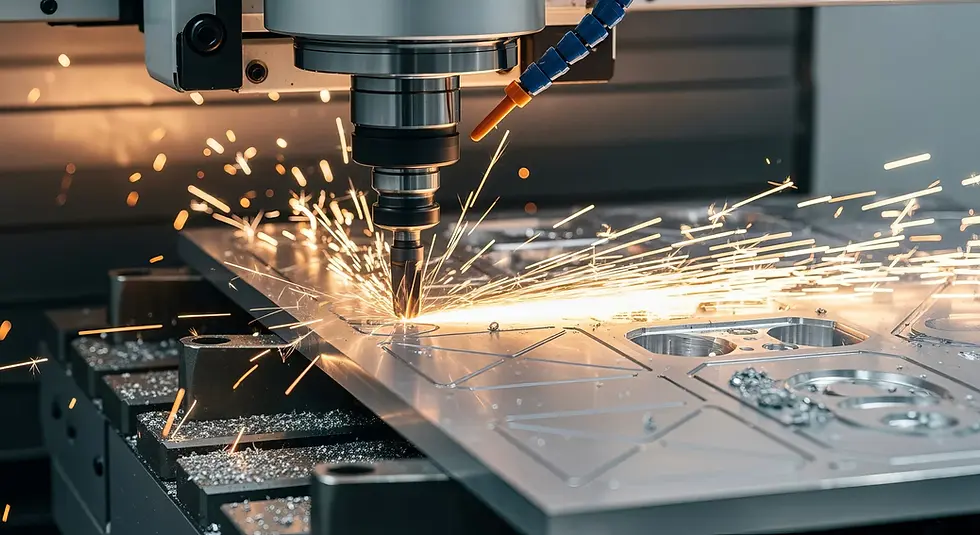
CNC milling is a machining process where a rotating cutting tool removes material from a stationary workpiece.
The workpiece is securely clamped to the machine table while multiple cutting tools move along programmed paths to create the desired geometry.
Because the cutting tool can move in multiple directions, CNC milling can produce highly detailed components with complex features.
Common Milling Operations
CNC milling is commonly used to create:
Flat surfaces
Slots
Pockets
Grooves
Contours
Valve cavities
Mounting surfaces
Precision holes
Modern CNC machining centers often operate on three, four, or five axes, allowing manufacturers to machine intricate parts with exceptional accuracy.
Advantages of CNC Milling
CNC milling offers several advantages for manufacturing complex components.
Produces Complex Geometries
Milling can machine irregular shapes that would be difficult or impossible using turning alone.
Excellent Accuracy
Computer-controlled movements allow milling machines to maintain tight dimensional tolerances.
High Versatility
A single milling machine can perform multiple machining operations without requiring significant setup changes.
Suitable for Many Materials
CNC milling works with:
Carbon steel
Stainless steel
Aluminum
Cast iron
Ductile iron
Brass
Bronze
Engineering plastics
This versatility makes milling suitable for a wide range of industrial applications.
What Is CNC Turning?
CNC turning removes material by rotating the workpiece while a stationary cutting tool shapes its outer or inner surfaces.
Because the material rotates during machining, turning is ideal for producing symmetrical cylindrical components.
Turning is commonly performed using CNC lathes that automatically control cutting depth, feed rate, and spindle speed.
Common Turning Operations
Typical turning operations include:
Straight turning
Facing
Grooving
Threading
Boring
Taper turning
Parting
These operations allow manufacturers to produce precise cylindrical features with excellent repeatability.
Advantages of CNC Turning
CNC turning provides several benefits for round or rotational components.
Efficient Production
Turning removes material quickly from cylindrical workpieces, making it highly efficient for production runs.
Excellent Surface Finish
The rotating workpiece often produces smooth, consistent surface finishes.
High Repeatability
Computer-controlled lathes can manufacture thousands of identical parts with minimal variation.
Lower Production Costs
For cylindrical parts, turning often requires fewer machining operations than milling, helping reduce machining time and production costs.
CNC Milling vs. CNC Turning
Although both processes use CNC technology, they differ in how material is removed and the types of parts they produce.
Feature | CNC Milling | CNC Turning |
Workpiece | Stationary | Rotates |
Cutting Tool | Rotates | Stationary |
Best For | Complex shapes | Cylindrical parts |
Common Features | Pockets, slots, flat surfaces | Shafts, pins, bushings |
Production Speed | Excellent for complex parts | Excellent for round parts |
Surface Finish | Excellent | Excellent |
Typical Equipment | CNC machining center | CNC lathe |
Common Applications of CNC Milling
CNC milling is widely used for components with intricate geometries and multiple machined features.
Examples include:
Hydraulic valve bodies
Hydraulic manifolds
Pump housings
Industrial brackets
Machine bases
Tooling components
Heavy equipment parts
Custom castings requiring secondary machining
These components often require multiple machined surfaces, threaded holes, and precision internal features.
Common Applications of CNC Turning
While CNC milling is ideal for producing complex geometries, CNC turning excels at manufacturing components with circular or rotational symmetry.
Because the workpiece rotates during machining, turning produces smooth, consistent cylindrical surfaces with excellent dimensional accuracy.
Common CNC turned components include:
Shafts
Bushings
Sleeves
Rollers
Hydraulic fittings
Bearing housings
Threaded connectors
Pins
Spacers
Couplings
These parts are commonly used in hydraulic systems, industrial machinery, heavy equipment, automotive applications, and agricultural equipment.
Which Process Is More Accurate?
Both CNC milling and CNC turning can achieve extremely tight tolerances when properly programmed and operated.
Rather than one process being inherently more accurate than the other, accuracy depends on several factors, including:
Machine calibration
Tool condition
Material properties
Programming quality
Workholding
Inspection procedures
For components with flat surfaces and complex features, milling often provides the required precision. For cylindrical components, turning typically offers exceptional dimensional consistency and surface finish.
Manufacturers select the process that best matches the geometry and functional requirements of the part.
Materials Compatible with Both Processes
Both CNC milling and CNC turning can machine a wide range of engineering materials.
The table below highlights some of the most common options.
Material | CNC Milling | CNC Turning | Common Applications |
Carbon Steel | ✓ | ✓ | Heavy equipment, industrial machinery |
Stainless Steel | ✓ | ✓ | Hydraulic systems, marine equipment |
Aluminum | ✓ | ✓ | Lightweight industrial parts |
Cast Iron | ✓ | ✓ | Pump housings, machine bases |
Ductile Iron | ✓ | ✓ | Hydraulic components |
Brass | ✓ | ✓ | Precision fittings |
Bronze | ✓ | ✓ | Bearings, bushings |
Engineering Plastics | ✓ | ✓ | Electrical and lightweight components |
Selecting the right material depends on factors such as operating pressure, corrosion exposure, wear resistance, weight, and machinability.
Can CNC Milling and CNC Turning Be Used Together?
Yes. Many industrial components require both machining processes to achieve the final design.
For example, a hydraulic valve body may begin as a casting before undergoing extensive CNC milling to create internal passages, mounting surfaces, and threaded ports.
Another component, such as a shaft, may first be CNC turned to create its cylindrical profile and then transferred to a milling machine to add:
Keyways
Flats
Cross holes
Mounting features
Threaded holes
Using multiple machining operations allows manufacturers to produce complex components while maintaining tight tolerances and high production efficiency.
How Manufacturers Choose Between Milling and Turning
Choosing the correct machining process begins with understanding the part's geometry and functional requirements.
Several factors influence this decision.
Part Shape
One of the first considerations is the overall shape of the component.
Generally:
Complex or irregular geometries are better suited for CNC milling.
Cylindrical or rotational parts are typically produced through CNC turning.
Required Features
The specific features needed on the finished component also play a role.
If the part requires:
Pockets
Slots
Flat surfaces
Multiple drilled holes
Intricate contours
CNC milling is often the preferred process.
If the part primarily consists of:
Cylindrical diameters
Threads
Tapers
Grooves
CNC turning is usually more efficient.
Production Volume
Production requirements also influence the manufacturing method.
For high-volume production of simple cylindrical parts, CNC turning often provides shorter cycle times and lower production costs.
For complex components requiring multiple features, CNC milling may reduce secondary operations and improve overall efficiency.
Material Selection
Some materials machine more efficiently using one process than another depending on part geometry, cutting forces, and tooling.
Experienced manufacturers evaluate both the material and the component design to determine the most effective production strategy.
Real-World Manufacturing Examples
Understanding how these processes are used together helps illustrate their role in industrial manufacturing.
Hydraulic Valve Bodies
Hydraulic valve bodies contain multiple internal passages, ports, and mounting surfaces.
These components are primarily produced using CNC milling because of their complex geometry and precision requirements.
Pump Shafts
Pump shafts require highly accurate cylindrical dimensions, making CNC turning the preferred manufacturing process.
Additional features such as keyways or cross-drilled holes may be added later through milling.
Industrial Brackets
Brackets often require flat surfaces, multiple hole patterns, and complex contours.
CNC milling provides the flexibility needed to manufacture these features accurately.
Bushings and Sleeves
Bushings and sleeves are rotational components that are efficiently produced through CNC turning.
Depending on the design, secondary milling operations may be performed to add lubrication grooves or other specialized features.
Benefits of Combining CNC Milling and Turning
Many manufacturers combine both machining processes to maximize efficiency and produce highly engineered components.
Benefits include:
Greater design flexibility
Improved dimensional accuracy
Fewer manufacturing limitations
Reduced secondary operations
Better overall production efficiency
Consistent quality across complex parts
By selecting the right process—or combining both—manufacturers can optimize production while meeting demanding engineering specifications.
Why Precision Machining Matters
In industrial manufacturing, precision is more than achieving the correct dimensions. It directly affects how components fit together, perform under load, and withstand long-term use.
Whether manufacturing hydraulic valve bodies, pump shafts, industrial hardware, or heavy equipment components, precision machining helps ensure:
Proper component fit
Reliable sealing performance
Reduced vibration
Improved wear resistance
Longer service life
Consistent product quality
Even small dimensional variations can impact hydraulic pressure, bearing alignment, or assembly, making precision machining a critical part of the manufacturing process.
Choosing the Right CNC Machining Partner
Selecting the right machining partner can significantly influence product quality, production efficiency, and project success.
Beyond having advanced equipment, an experienced manufacturer should understand material properties, machining strategies, quality control, and the specific requirements of industrial applications.
When evaluating a CNC machining supplier, consider the following factors:
Selection Factor | Why It Matters |
CNC capabilities | Ensures the supplier has the equipment needed for your project. |
Material expertise | Helps select the right material based on strength, wear resistance, and corrosion requirements. |
Engineering support | Improves manufacturability and identifies potential production challenges early. |
Quality control | Confirms parts meet dimensional and performance specifications. |
Production capacity | Supports both prototype development and high-volume manufacturing. |
Secondary operations | Reduces lead times by offering machining, finishing, heat treatment, and inspection under one roof. |
Working with a manufacturer that offers multiple manufacturing capabilities can simplify production while improving consistency from one part to the next.
Common Mistakes When Choosing a Machining Process
Choosing between CNC milling and CNC turning isn't always straightforward. Understanding the part's design and performance requirements helps avoid unnecessary costs and production delays.
Selecting the Wrong Process
Choosing milling for a simple cylindrical part—or turning for a highly complex component—can increase machining time and production costs.
Evaluating the part geometry first helps determine the most efficient manufacturing method.
Overlooking Secondary Operations
Many components require additional processes after primary machining.
Heat treatment, grinding, coating, deburring, or finishing may all be necessary to achieve the required performance.
Considering these operations during the planning stage can help reduce lead times and avoid costly redesigns.
Ignoring Material Properties
Not all materials machine the same way.
Factors such as hardness, corrosion resistance, thermal expansion, and chip formation can influence machining strategy and tooling selection.
Choosing the appropriate material for the application helps improve both manufacturing efficiency and long-term performance.
Focusing Only on Initial Cost
Lower machining costs do not always result in the best overall value.
Quality, repeatability, material selection, and manufacturing expertise all contribute to the total lifecycle cost of a component.
Evaluating long-term reliability often provides a better return on investment than choosing the lowest initial quote.
Why Manufacturing Experience Matters
Many industrial components require more than one manufacturing process.
A component may begin as a custom casting or forging before undergoing CNC milling, turning, drilling, finishing, and inspection.
Industrial manufacturers with experience across multiple production methods can recommend the most efficient workflow while maintaining tight tolerances and consistent quality.
This integrated approach can help reduce production complexity, shorten lead times, and improve overall component performance.
Conclusion
CNC milling and CNC turning are both essential manufacturing processes, but each serves a different purpose.
CNC milling is ideal for producing complex geometries, precision holes, slots, pockets, and flat surfaces, while CNC turning excels at manufacturing cylindrical components such as shafts, bushings, and sleeves.
Rather than competing processes, milling and turning often work together to produce finished industrial components that meet demanding engineering specifications.
Understanding the differences between these machining methods helps engineers, designers, and procurement teams choose the right manufacturing approach based on the part's geometry, material, tolerances, and production requirements.
Partnering with an experienced manufacturer ensures that the appropriate machining processes are selected to produce high-quality components efficiently and consistently.
Your Partner for Precision CNC Machining
BMF Industrial provides custom CNC machining solutions for a wide range of industrial applications. Our capabilities include precision CNC milling, CNC turning, custom casting, custom forging, machining, finishing, and material selection to support everything from prototype development to full-scale production.
Whether you need complex hydraulic valve bodies, precision shafts, industrial hardware, or custom metal components, our team works closely with engineers and procurement professionals to deliver reliable manufacturing solutions designed for demanding applications.
Contact BMF Industrial today to discuss your next CNC machining project.
Frequently Asked Questions About CNC Machining
What is the main difference between CNC milling and CNC turning?
CNC milling uses a rotating cutting tool to remove material from a stationary workpiece, making it ideal for complex shapes and flat surfaces. CNC turning rotates the workpiece while a stationary cutting tool shapes cylindrical components such as shafts and bushings.
Which is better, CNC milling or CNC turning?
Neither process is inherently better. The right choice depends on the component's geometry, required features, material, tolerances, and production requirements. Many parts use both processes during manufacturing.
Can a part require both CNC milling and CNC turning?
Yes. Many industrial components are first turned to create cylindrical features and then milled to add holes, slots, flats, threads, or other precision features.
What materials can be machined using CNC milling and turning?
Both processes are compatible with materials such as carbon steel, stainless steel, aluminum, cast iron, ductile iron, brass, bronze, titanium, and engineering plastics.
Which process is more accurate?
Both CNC milling and CNC turning can achieve extremely tight tolerances. Accuracy depends on machine calibration, tooling, programming, workholding, and inspection rather than the machining process itself.
What industries commonly use CNC milling and CNC turning?
These machining processes are widely used in hydraulics, construction equipment, agriculture, mining, heavy machinery, automotive, aerospace, marine, oil and gas, and general industrial manufacturing.
How do manufacturers choose between milling and turning?
Manufacturers evaluate factors such as part geometry, required features, material selection, production volume, and tolerance requirements to determine the most efficient machining process.


Comments